

Around… 14? Years ago? Now? I realized that I really wanted to write, but that my job—at the time building houses—precluded my ability to do so in any sustained, satisfying matter, on account of it sucking so much of the energy from my body. So I made the decision to “go back to school,” thinking that perhaps there I would be able to redirect said energies toward what I ~really~ wanted to do (or at least get a little closer to that reality).
About a decade later, after a brutal comedy of errors, I found myself frantically trying to remove myself from the mess that decision got me into. What did I want to do? What could I do—I mean: what did I have the skills to do? As fate would have it, a dear friend I’d made toward the end of that decade had some carpentry work that needed done. That summer, as I did said work, I realized not only was I good at it, but I enjoyed it. I decided that I would once again like to “work with my hands.”
About a year and a half ago I got a job with a small local design/ build landscaping company, and have been able to do exactly what I decided I’d like to do, much like the reverse (at least for a time), had been true all those years ago. It has been thrilling being out in the sun, up early, using my body while developing new skills and reawakening old ones, and in the end producing some pretty remarkable constructions.
But now I’m tired again. And this tiredness is exacerbated by the desire I have, once I’m home and settled (and have taken my daily 40-minute nap), to sit down and do some of the writing I spend so much of the day daydreaming about.
I’m not sold on the language, or the metaphor, of life happening in “cycles.” I suppose in many ways it’s an accurate heuristic for understanding “the passage of time” (also a grammar I hate), but I cannot help but constantly be reminded by the fact that while “this” has happened before and is, in some sense, happening “again,” yet I am still— necessarily—not “back there.” I am not looking for a new analogy, I just want to point out—and affirm, really—what is both wrong and interesting about it: the contradiction or paradox of “time as a cycle.” The hiccup, the glitch, the divot.
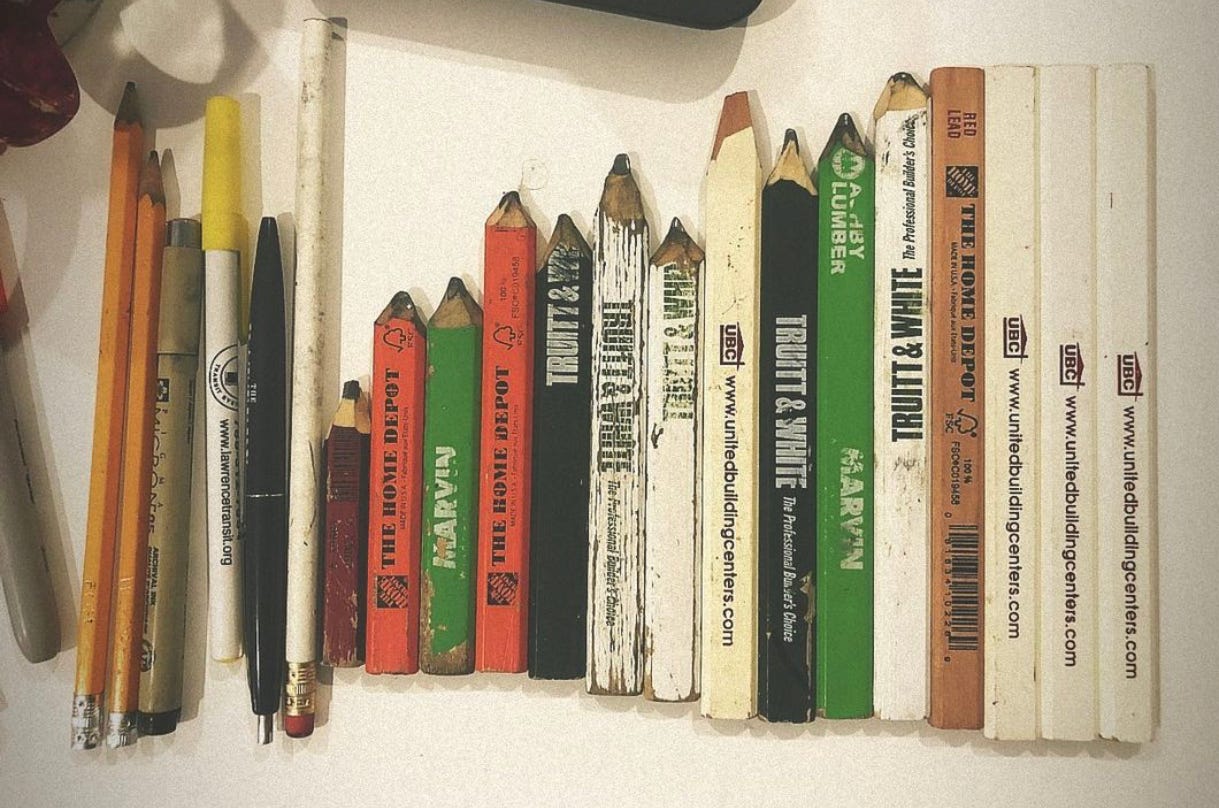
For one thing, I am not the me of then. I take responsibility for the me of then—I have memory and will, after all—but the me of now has a whole different relationship (for another thing), to his desires, his frustrations, his mis/understandings, his responsibility towards himself and others. Of course the beautiful thing about the me of then and now being wedded to a narrative of cyclicality is that the me of then is also responsible for the me of now, which is why the me of just then (closer to now than back then), was able to get a job building things, among other things, for a whole other (third) thing.
So I am in a familiar place and I am also in an unfamiliar place. That is: I am in an uncanny space, which is beautiful in its way because the apprehension of it as such is like a living dream. And scary because the stakes are very much rooted in the material reality of waking life.
Whichhhh brings me to an unexpected hypothesis: that part of the reason we call things cyclical—this weird constant return to familiar things, places, events, etc.— is because of what Bill Brown called “the uncanniness of everyday life” (way back in 1998). I like thinking of it this way because I’m actually very wary of the compulsion to narrativize things, and have always suspected that the attempt to describe life or time as a cycle as an attempt to de-linearize time has never really been successful in doing so. Life as an uncanny experience feels not only like it adequately fucks with linear narrativization, but also (ironically?) is more “true to life.” If you will.
Also if you will and if you’d like to read more of this writing that I’m always talking about wanting to do, I would really appreciate it if you’d check out an article I wrote on Medium last January about a favorite topic of mine, Krampus, Santa as a cop, and Christmas as a massive gaslighting project. In it I do a reading of the 2015 film Krampus, as well as a reading of the 2014 Bojack Horseman Christmas episode, which really, I think, explicates the oftentimes confusing minutiae of the mechanics of gaslighting, and how that saturates patriarchal culture.